
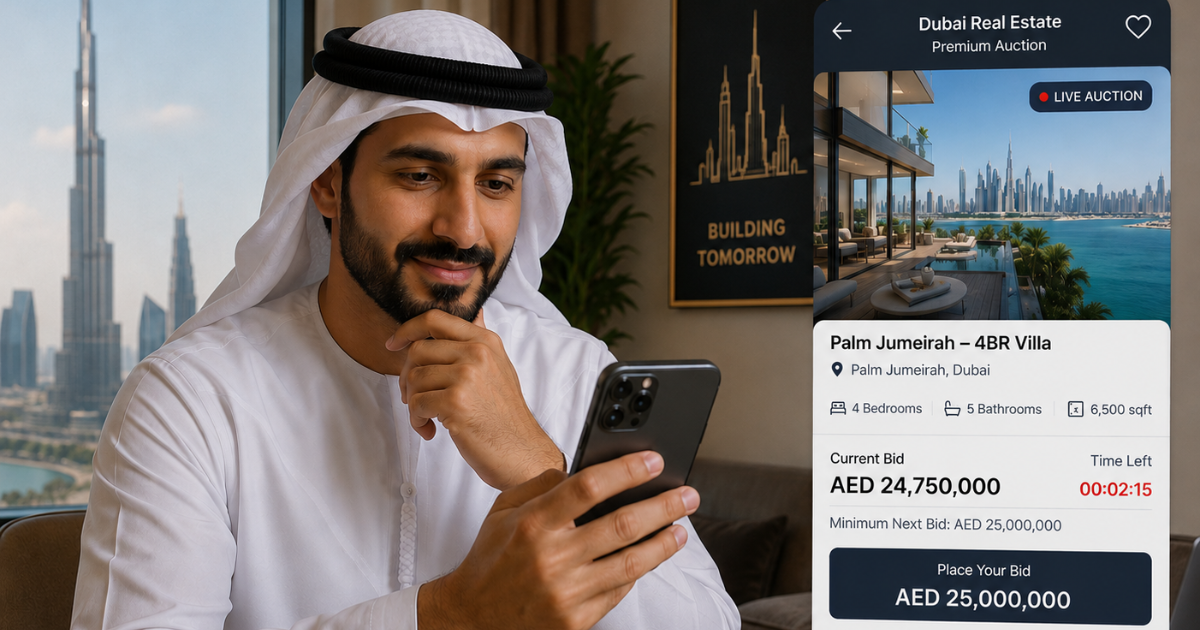
Global Property Auctions vs Boli.ae Digital Auctions in the UAE Property Market
When the topic of high-value auctions surfaces in Dubai, the conversation typically gravitates toward rare license plates commanding AED 50,000,000 at a DIFC gala, or a Bugatti Chiron sold in under four minutes at a downtown auction house. Real estate, the city's most significant asset class, has largely remained outside that arena, not because the model is untested, but because no platform has built the infrastructure to make it work at scale. That absence is striking when you consider the numbers: Dubai recorded AED 761 billion in total real estate transactions in 2024, a market drawing capital from every major financial center on the planet.
Investors based in London, Mumbai, Moscow, and Shanghai are allocating significant portions of their portfolios to UAE property, yet the transaction process itself, the negotiation, the verification, and the paperwork, have remained largely analogue. Buyers and brokers still move through a sequence of phone calls, email chains, and physical document exchanges that belong to a different era. In mature Western markets, this problem was addressed long ago.
The auction format emerged as a structurally superior alternative to private treaty sales precisely because it eliminates the inefficiencies of bilateral negotiation: opaque pricing, drawn-out timelines, and deals that fall apart after weeks of back-and-forth. In the UK, Australia, and the US, property auctions are not a niche mechanism reserved for distressed assets. They are the standard. Dubai, a city that has led the region in digital government services, blockchain-based land registration, and smart city infrastructure, has the foundations to do so better than anyone else. What it needed was a platform purpose-built for its market, one that kept the competitive rigour of the global auction model while replacing every manual dependency with automation and real-time data. That is precisely the gap Boli.ae was designed to close.
Property Auction Dubai: A Proven Model Long Established in Mature Markets
Property auctions are not a novel experiment. Across the United Kingdom, Australia, and the United States, the auction format has served as the primary mechanism for residential and commercial real estate transactions for well over a century. In Sydney's inner suburbs, weekend auctions on front driveways are a cultural fixture. In London, property auction houses such as Allsop and Savills regularly clear hundreds of lots per session, generating billions in annual transaction volume.
The institutional appeal is straightforward: auctions impose market discipline. Price discovery happens in real time, driven by competitive demand rather than bilateral negotiation between parties with asymmetric information. Every participant observes the same bids simultaneously. There are no off-market side deals, no undisclosed vendor expectations, and no opaque counteroffers. The final price is, by definition, what the market is prepared to pay at that moment. This structural transparency has driven strong long-term adoption.
The Royal Institution of Chartered Surveyors (RICS) notes that auction transactions typically complete within four to six weeks of the sale, a timeline that private treaty sales rarely match. The mechanism works. The question for Dubai was never whether the model had merit; it was whether the city had the technical infrastructure to execute it properly.
Why the Traditional Dubai Property Auction Format Could Not Scale
The operational architecture of a conventional property auction carries one fundamental constraint: physical presence. Bidders must assemble in a specific room, on a suburban lawn, or at a registered venue. They raise paddles or call out figures to an auctioneer, managing competing voices in real time. Identity verification happens through manual registration. Legal documentation is processed in sequential, paper-heavy workflows.
This model is incompatible with Dubai's investor geography. The emirate recorded AED 761 billion in total real estate transactions in 2024, according to the Dubai Land Department (DLD), a 20 percent increase in value year-on-year, with a significant proportion of that capital originating from buyers based in India, the United Kingdom, Russia, China, and continental Europe. A transaction format that requires physical attendance at a specific location on a fixed date functionally excludes the majority of Dubai's international investor base before a single bid is placed. The infrastructure gap was not a matter of investor appetite. Global capital has consistently demonstrated a willingness to allocate to UAE real estate. The gap was logistical and ultimately, technological.
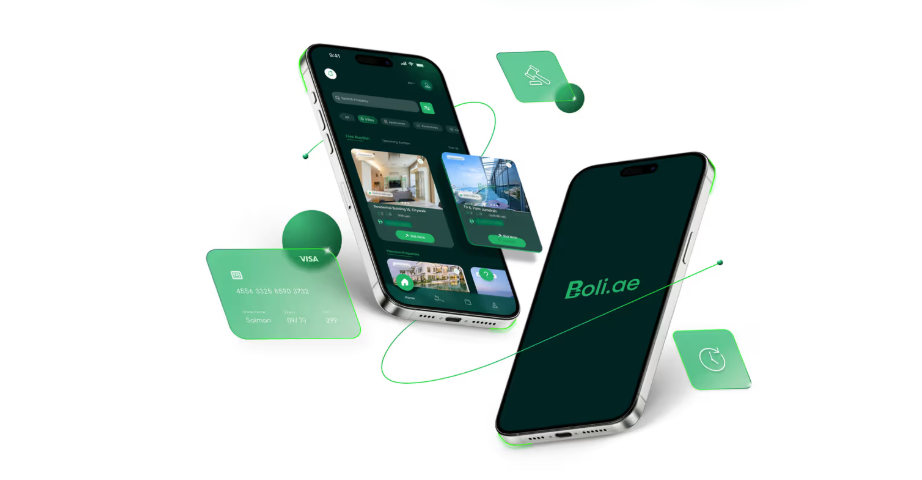
Boli.ae, the UAE's leading digital property auction platform, was built to retain the competitive integrity and price transparency that make the auction format structurally superior while replacing every physical and manual dependency with automated, AI-augmented workflows.
As Imran Agha, Founder and Chief Executive Officer of Boli.ae, states directly: "The idea was to get the auction in, but have it very automated, very digitalized, and have a lot of AI and all those things put together."
That directive has shaped every layer of the platform. The onboarding process eliminates the traditional pre-registration bottleneck through automated digital verification. The bidding interface operates in real time, with all participants viewing an identical, tamper-proof record of competing offers. Post-auction execution is structured to close without the weeks of document exchange that characterize legacy transaction processes.
Why Dubai is the Optimal Environment for an Online Real Estate Auction Platform
Dubai's regulatory and technological environment is structurally suited to this kind of platform deployment. The DLD has invested significantly in digital transaction infrastructure, including blockchain-based title deed issuance and API-integrated developer compliance systems. The Real Estate Regulatory Agency (RERA) maintains a transparent register of licensed brokers and projects. Smart Dubai's broader mandate to migrate government services online has created a policy environment where digital-first transaction models face fewer institutional barriers than in most comparable markets. The combination of a digitally literate investor base, an internationally active buyer profile, and a regulatory framework aligned with PropTech innovation creates the conditions in which a platform like Boli.ae does not merely operate, but scales.
The Investment Thesis for Dubai Property Auction Participation
For investors operating in Dubai's secondary and primary markets, Boli.ae addresses three persistent friction points: speed, transparency, and geographic access. The traditional private treaty process, offer, counteroffer, solicitor review, and title transfer routinely extends across sixty to ninety days. An auction closes a transaction in minutes, with legal processes built directly into the post-close workflow.
For institutional buyers managing portfolio allocation timelines, this compression is material. Price transparency eliminates the information asymmetry that typically advantages listing agents in bilateral negotiations. Every bidder operates from the same data set. The clearing price reflects genuine market demand, not the outcome of a negotiation in which one party had privileged access to vendor motivation.
Geographic access converts what has historically been a local asset class into a borderless one. A qualified investor in Singapore or Frankfurt faces no structural disadvantage relative to a buyer physically present in Dubai Marina. The global property auction model has decades of institutional validation behind it. What it lacked until now was the digital infrastructure to function across time zones, borders, and regulatory environments simultaneously.
Boli.ae has built that infrastructure. The platform does not reimagine the auction; it operationalizes it at a scale and speed that Dubai's market demands. For investors seeking transparent, efficient, and geographically unrestricted access to UAE real estate, the mechanism is no longer experimental; it is live.
Visit Boli.ae or download the app to participate in Dubai's premier digital real estate auction platform.